

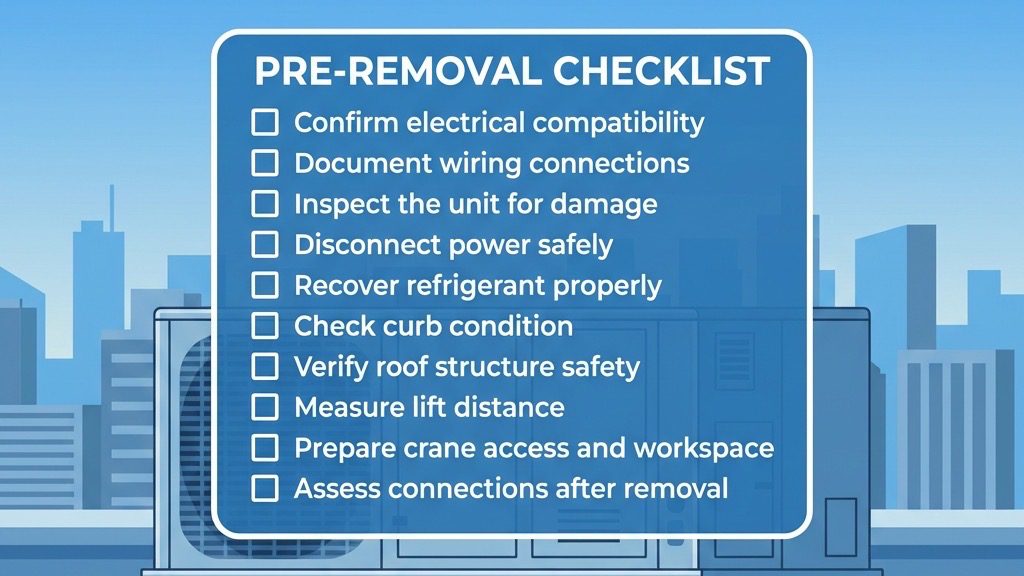
Removing a rooftop AC unit is far more complex than it appears. These commercial HVAC systems serve entire buildings, and any oversight during removal can lead to costly delays, structural damage, or safety hazards. This comprehensive guide covers the 10 critical checks every contractor must complete before crane day arrives.
1. Why Pre-Removal Planning Matters
A successful rooftop unit replacement doesn't begin when the crane arrives—it starts with thorough pre-inspection. Rooftop AC units are positioned in challenging locations, serving large commercial spaces with complex electrical and mechanical systems. Any gap in preparation can cascade into budget overruns, schedule delays, or worse—roof damage and safety incidents.
Pro Insight: The most experienced HVAC teams spend 40% of project time on pre-removal planning. This investment consistently pays off in faster, safer installations.
Key pre-inspection activities include verifying the unit's electrical parameters, documenting original system wiring, and confirming the replacement model matches the building's electrical infrastructure. These seemingly routine steps form the foundation for a smooth removal operation.
2. Electrical Verification and Equipment Inspection
One of the most overlooked—yet critical—steps in rooftop unit demolition is confirming electrical compatibility between the old and new units. Voltage discrepancy is the most common issue in replacement projects, and also the most likely to cause significant losses if not caught early.
Documentation Before Disconnection
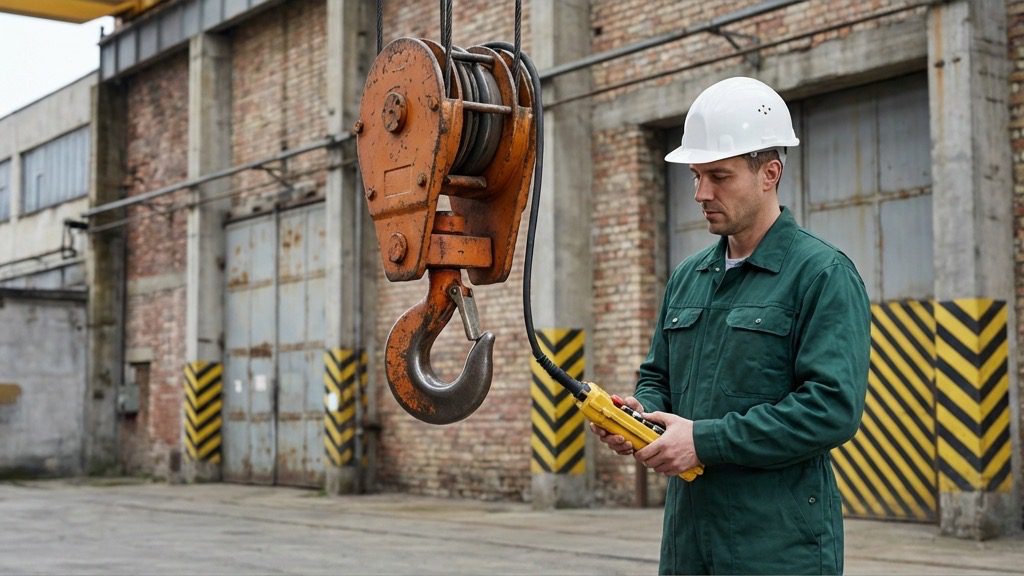
Before disconnecting any lines, technicians should photograph both high-voltage and control-side wiring. This documentation ensures accurate reconnection and serves as a reference if troubleshooting is needed later.
Pre-Lift Damage Assessment
Transport damage inspections must be completed before the new unit is lifted into position. Check for:
- Visible dents or panel damage
- Bent coil fins that may restrict airflow
- Smooth fan blade rotation
- Intact electrical connections and control boxes
These inspections demonstrate professionalism and prevent liability disputes after installation is complete.
3. Creating a Safe Work Environment
Rooftop AC unit removal involves multiple high-risk operations: height work, electrical power interruption, refrigerant recovery, and heavy lifting equipment coordination. Safety and on-site organization capabilities are absolutely critical.
Pre-Removal Safety Checklist
- Power supply disconnected by qualified personnel the day before removal
- Refrigerant recovery completed by certified technicians
- Roof area cleared and structural stability verified
- Access paths confirmed safe for personnel and equipment
- Parking spaces reserved for crane and support vehicles
- Temporary placement areas planned for unit staging
When dealing with large commercial rooftop units, a well-organized construction environment isn't an optional extra—it's a fundamental requirement for project success.
4. Precision Crane Planning for Efficient Operations
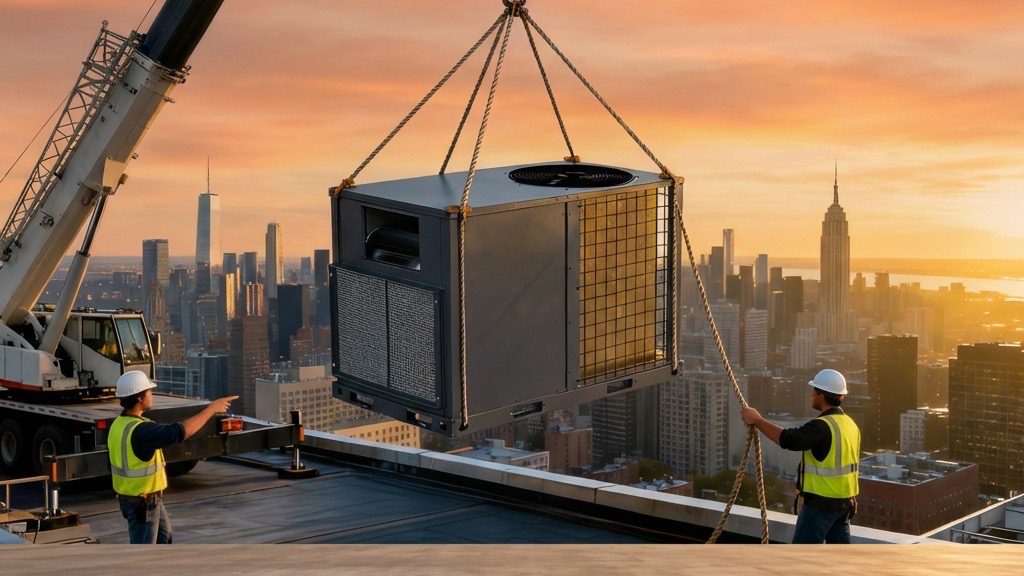
Hoisting is typically the most expensive, highest-risk, and most time-sensitive phase of any rooftop unit replacement project. Detailed pre-planning of lifting operations is essential.
Critical Crane Specifications
Crane type, boom length, and lifting capacity must be calculated based on:
- Horizontal distance from ground-level crane position to roof edge
- Vertical height to the installation point
- Weight of the unit being removed (and the replacement)
- Available ground clearance and swing radius
Day-of Coordination
The construction team should arrive before the crane to communicate lifting routes and action sequences with the operator. After the old unit is removed, immediately inspect the roof curb structure, sealing materials, and waterproof membrane condition before positioning the new unit.
Detailed pre-planning significantly reduces waiting time and ensures rooftop AC unit replacement projects are completed within budget and schedule.
5. Post-Removal Connection Preparation
When the old rooftop unit is lifted off the base, attention should immediately shift to preparing for new unit installation. Many details at this stage are often overlooked, yet they directly affect installation quality and system performance.
Pre-Installation Verification
- Check if ductwork interfaces need adjustment
- Verify electrical cable lengths are sufficient
- Inspect control wiring for damage or wear
- Assess roof penetrations and seals for potential re-treatment
Any issues should be resolved before the new unit is lifted into position. This prevents costly rework and ensures the system starts up smoothly during commissioning.
Making Every Replacement Project a Success
Removing a rooftop AC unit is never a simple "out with the old, in with the new" operation. It's an engineering project requiring strict process management across electrical verification, refrigerant recovery, safety planning, crane coordination, and structural inspection.
For professional HVAC teams, thorough preparation not only reduces errors and improves efficiency—it builds client trust. Solid pre-planning is the key to successful rooftop unit replacement and the core value that distinguishes experienced contractors from the rest.
Ready to Plan Your Next RTU Project?
Our team brings decades of commercial HVAC experience to every rooftop unit replacement. Let's discuss your requirements.
Get Expert Consultation English
  Français
  Español
  العربية
  Türkçe
  Русский
  Deutsch
  Tiếng Việt
  ไทย
ไทย  Bahasa Melayu
  Bahasa Indonesia
  Italiano