

While Mini Splits and VRF systems share a common DNA in direct expansion technology, they serve vastly different masters. Understanding their distinct mechanisms is key to selecting the right climate control solution for your project.
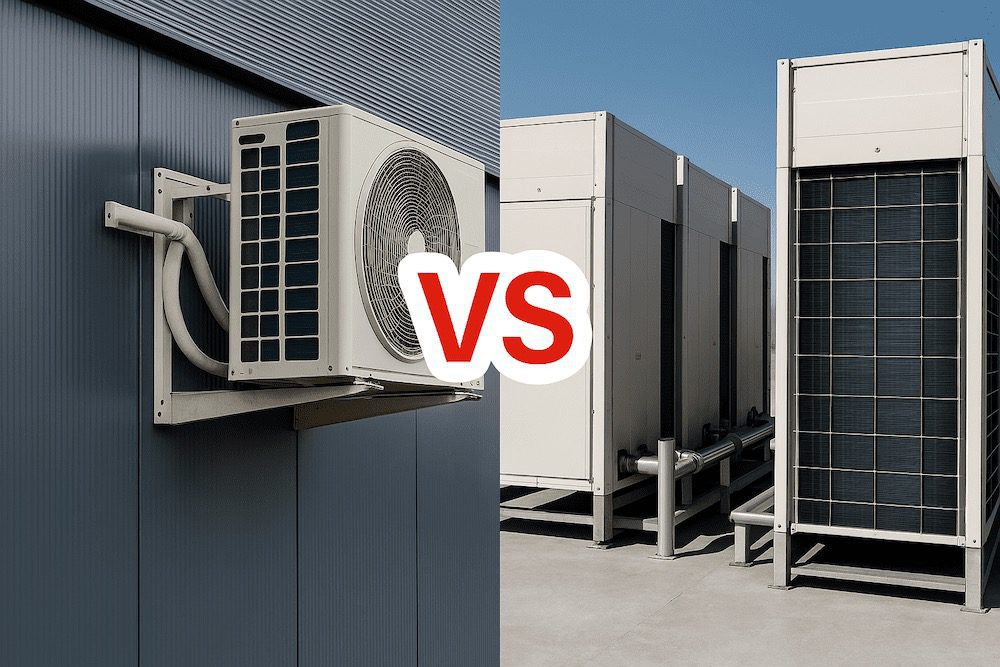
The Shared Foundation: Direct Expansion
Both Mini Split and Variable Refrigerant Flow (VRF) systems operate on the fundamental principle of Direct Expansion (DX). Unlike chilled water systems that use an intermediate fluid, DX systems circulate refrigerant directly to the indoor evaporator coils. This direct approach offers rapid temperature control and high efficiency.
Did You Know? While all VRF systems are technically DX systems, not all DX systems are VRF. The distinction lies in the sophistication of refrigerant management.
Deep Dive: Variable Refrigerant Flow (VRF)
VRF systems represent the evolution of DX technology. "Variable Refrigerant Flow" refers to the system's ability to intelligently modulate the amount of refrigerant sent to each indoor unit based on specific demand.
A VRF system typically uses a single main refrigerant pipe that branches out to multiple indoor units using specialized Y-joints or distribution boxes. This streamlined piping architecture allows for massive scalability—connecting dozens of indoor units to a single outdoor module.
Key Differences: A Comparison
Choosing between these two technologies often comes down to scale, control requirements, and budget. Here is a breakdown of the critical differences:
1. Piping Architecture
Mini Splits (even multi-zone ones) require dedicated line sets ("home runs") for each indoor unit back to the outdoor unit. In complex installations, this results in a "spaghetti" of copper lines. VRF systems, by contrast, use a streamlined trunk-and-branch design, significantly reducing installation complexity in large buildings.
2. Scalability and Capacity
Why Scale Matters
- Mini Splits: Best for 1-5 zones. Limited line lengths (typically under 200 ft total). Great for residential or small offices.
- VRF Systems: Designed for 50+ zones. Extensive piping runs (up to 3000 ft total). Ideal for large commercial spaces, hotels, and luxury homes.
| Feature | Mini Split System | Hệ thống VRF |
|---|---|---|
| Core Tech | Standard Direct Expansion | Intelligent Variable Flow |
| Piping | Individual pairs per unit | Single main line with branches |
| Scalability | Low (Residential/Small Commercial) | High (Large Commercial) |
| Control | Individual Remote/Simple Thermostat | Centralized BMS Integration |
Making the Choice
If you are cooling a single room, a home addition, or a small office, a Mini Split is the cost-effective champion. It offers excellent efficiency without the complexity of VRF.
However, for multi-story buildings, large luxury residences, or commercial facilities requiring granular control and energy management, VRF is the superior choice. Its ability to recover heat (simultaneous heating and cooling) and integrate with building management systems makes it a powerful asset.

Need Expert Advice?
Our team specializes in designing the perfect climate control solution for your specific needs.
Contact Us Today English
  Français
  Español
  العربية
  Türkçe
  Русский
  Deutsch
  Tiếng Việt
  ไทย
ไทย  Bahasa Melayu
  Bahasa Indonesia
  Italiano