

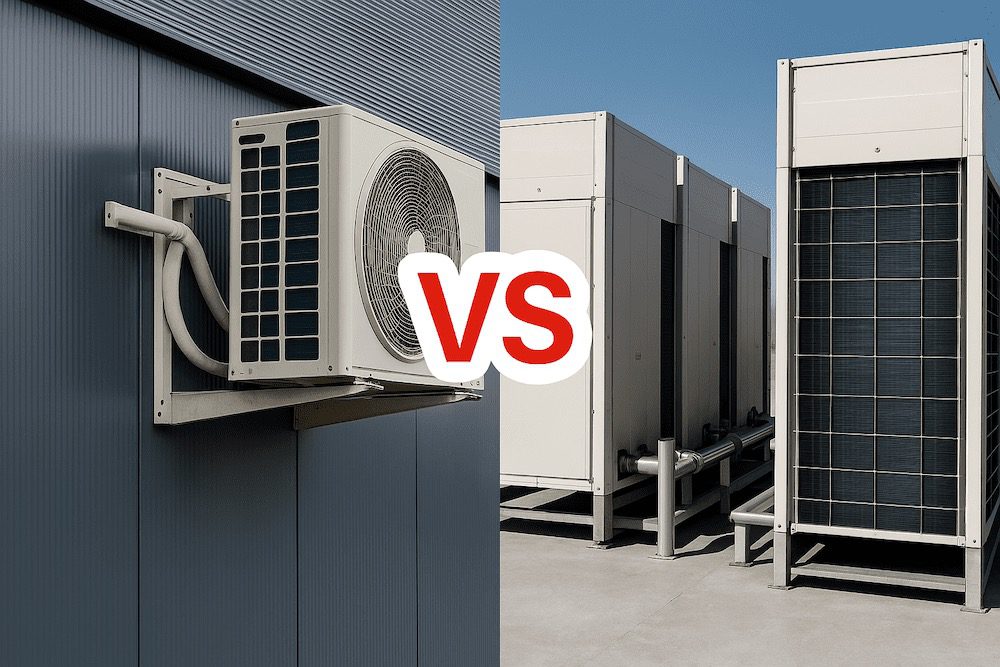
At first glance, Mini Split and Variable Refrigerant Flow (VRF) systems can look remarkably similar. Both move refrigerant directly to indoor units, eliminating bulky ductwork and boosting efficiency. However, choosing between them isn't just a coin flip—it's a decision that impacts scalable capacity, control precision, and project cost.
The Shared DNA: Direct Expansion Technology
Before diving into the differences, it’s important to understand what connects these two technologies. Both rely on Direct Expansion (DX), meaning the refrigerant—not chilled water—travels directly to the indoor fan coils to cool or heat the air.
Common Ground: Both systems are known for their high energy efficiency and flexibility compared to traditional forced-air commercial systems, but their architecture diverges significantly behind the scenes.
Are They the Same Thing?
Technically, a VRF system is a more sophisticated cousin of the multi-zone mini split, but the terms shouldn't be used interchangeably in a commercial context.
The Piping Difference
Multi-Zone Mini Split: Imagine a "spaghetti" layout. Each indoor unit typically requires its own dedicated copper line set running all the way back to the outdoor compressor. This limits the number of units and the distance they can be from the core.
VRF System: Uses a single main refrigerant capability trunk that branches out to various units using specialized "refnet" joints. This streamlined architecture allows for vastly longer pipe runs and dozens of indoor units connected to a single outdoor module.
Key Differences at a Glance
To help you decide which system fits your project, let's look at the core performance metrics.
| Feature | Mini Split System | نظام VRF |
|---|---|---|
| Scale | Residential / Small Commercial | Large Commercial / High-End Residential |
| Unit Capacity | Typically up to 5-9 indoor units | Up to 64+ indoor units |
| Piping Limit | Restricted (e.g., 200-300 ft total) | Extensive (up to 3000+ ft total) |
| Energy Efficiency | High | Very High (esp. with Heat Recovery) |

Why Choose VRF?
- Heat Recovery: Some VRF systems can heat one room while cooling another simultaneously.
- Centralized Control: Seamless integration with Building Management Systems (BMS).
- Space Saving: Fewer outdoor units are needed for a large building footprint.
Conclusion: Which One Do You Need?
If you fit out a small retail shop, a couple of classrooms, or a custom home, a Mini Split system offers a cost-effective, energy-efficient solution without the complexity.
However, for multi-story office buildings, hotels, or large luxury properties where independent climate control is needed across many zones, VRF technology is the undisputed champion.
Still Unsure?
Our engineering team can analyze your floor plan and recommend the most efficient system for your budget.
Request a System Design Consultation English
  Français
  Español
  العربية
  Türkçe
  Русский
  Deutsch
  Tiếng Việt
  ไทย
ไทย  Bahasa Melayu
  Bahasa Indonesia
  Italiano